


The PostgreSQL
REGEXP_MATCHES()
function matches a regular expression against a string and returns matched substrings.
Syntax
The following illustrates the syntax of the PostgreSQL
REGEXP_MATCHES()
function:
REGEXP_MATCHES(source_string, pattern [, flags])Code language: CSS (css)Arguments
The
REGEXP_MATCHES()
function accepts three arguments:
1)
source
The
source
is a string that you want to extract substrings that match a regular expression.
2)
pattern
The
pattern
is a POSIX regular expression for matching.
3)
flags
The
flags
argument is one or more characters that control the behavior of the function. For example,
i
allows you to match case-insensitively.
Return Value
The
REGEXP_MATCHES()
function returns a set of text, even if the result array only contains a single element.
Examples
Suppose, you have a social networking’s post as follows:
'Learning #PostgreSQL #REGEXP_MATCHES'Code language: JavaScript (javascript)
The following statement allows you to extract the hashtags such as
PostgreSQL
and
REGEXP_MATCHES
:
SELECT
    REGEXP_MATCHES('Learning #PostgreSQL #REGEXP_MATCHES',
         '#([A-Za-z0-9_]+)',
        'g');Code language: JavaScript (javascript)
In this example, the following regular expression matches any word that starts with the hash character (
#
) and is followed by any alphanumeric characters or underscore (
_
).
#([A-Za-z0-9_]+)Code language: PHP (php)
The
g
flag argument is for the global search.
The following is the result:
regexp_matches
-----------------
 {PostgreSQL}
 {REGEX_MATCHES}
(2 rows)
The result set has two rows, each is an array , which indicates that there are two matches.
Noted that the
REGEXP_MATCHES()
returns each row as an array, rather than a string. Because if you use groups to capture parts of the text, the array will contain the groups as shown in the following example:
SELECT REGEXP_MATCHES('ABC', '^(A)(..)$', 'g');Code language: JavaScript (javascript)The result is:
regexp_matches
----------------
 {A,BC}
(1 row)
See the following film table from the sample database:
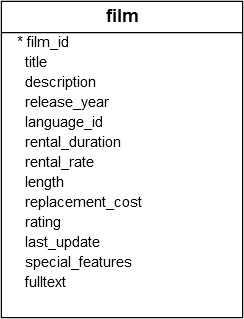
The following statement uses the
REGEXP_MATCHES()
function to get films whose descriptions contain the word
Cat
or
Dog
:
SELECT
	film_id,